
Madison County Parole vs Probation
Parole and probation both place a released Madison County person under supervision, but they begin from different legal events. Parole usually follows a state-prison sentence. The Alabama Board of Pardons and Paroles may grant parole, and the Alabama Bureau of Pardons and Paroles handles supervision resources after release. Probation usually comes from a court sentence that lets the person serve part or all of the sentence in the community under conditions. A Madison County jail release can be tied to probation, but the sheriff roster alone will not explain the whole court order.
Use the type of release to choose the right record path. A person released from the Madison County Detention Facility after a bond or local sentence may need a court docket check. A person released from ADOC prison may need the ADOC offender search, ABPP hearing results, and ABPP supervision resources. A parole result is a board action; it is not the same as the exact moment a person walks out of custody.
| Supervision type | What it means | Where Madison County users verify it |
|---|---|---|
| Parole | Conditional release from an Alabama prison sentence before full discharge. | Alabama Bureau of Pardons and Paroles, parole hearing pages, ADOC, and VINE. |
| Probation | Court-ordered supervision that may follow a plea, sentence, split sentence, or revocation event. | Madison County court records, ABPP field resources, and the sentencing court. |
| Discharge | The end of custody or supervision for that sentence or supervision term. | ADOC, ABPP records, court orders, or a public-records request. |
- Parole
- A supervised prison release controlled by the parole board and related statutes.
- Probation
- A court supervision term that may begin without an ADOC prison stay.
- Absconder
- A person ABPP identifies as missing from required supervision contact.
- Revocation
- A court or board action that can return a supervised person to custody.
Verify Madison County Post-Release Supervision
Madison County post-release supervision is not verified by searching only the current jail roster. A released person normally drops from the current Madison County Detention Facility list, and the released roster only confirms a recent exit from sheriff custody. Supervision may be visible through ABPP hearing and field-office resources, the court docket, ADOC for state-prison custody, or VINE if the custody feed still tracks the person.
- Start with the custody type. Use the Madison County released roster for a recent jail release and ADOC for a person transferred to Alabama prison custody.
- Check scheduled parole hearings if the question is whether parole consideration is pending.
- Review current-year parole results or previous-year parole results for board action.
- Use ABPP field offices by county and the Huntsville reporting resources to locate the likely supervision channel.
- For the final case outcome, check the Madison County court path or request records from the agency that created the record.
For a broader custody-release search, the Madison County released inmate search path on the home page separates jail release, prison release, court disposition, and supervision. That distinction matters because a person can be released from the county jail and still be in ADOC custody, on parole, on probation, or waiting for a later court date.
Madison County ABPP Resources
The Alabama Bureau of Pardons and Paroles is the statewide parole and probation agency named in the Madison County research. The safest local wording is to use ABPP's own field-office and day-reporting pages, because the research did not establish a separate street address for a specific Madison County supervision office. Huntsville is the county seat, and ABPP's Huntsville Day Reporting Center page is a relevant local reporting and reentry resource for the supervision landscape.
Alabama Bureau of Pardons and Paroles
Main site: paroles.alabama.gov
Field offices: Field offices by county
Huntsville resource: Huntsville Day Reporting Center
Records: ABPP public records requests
The Huntsville Day Reporting Center page is shown in the project image set as a local supervision resource, not as a jail-release list. It helps explain where some supervision and reentry reporting may route after a Madison County custody event.
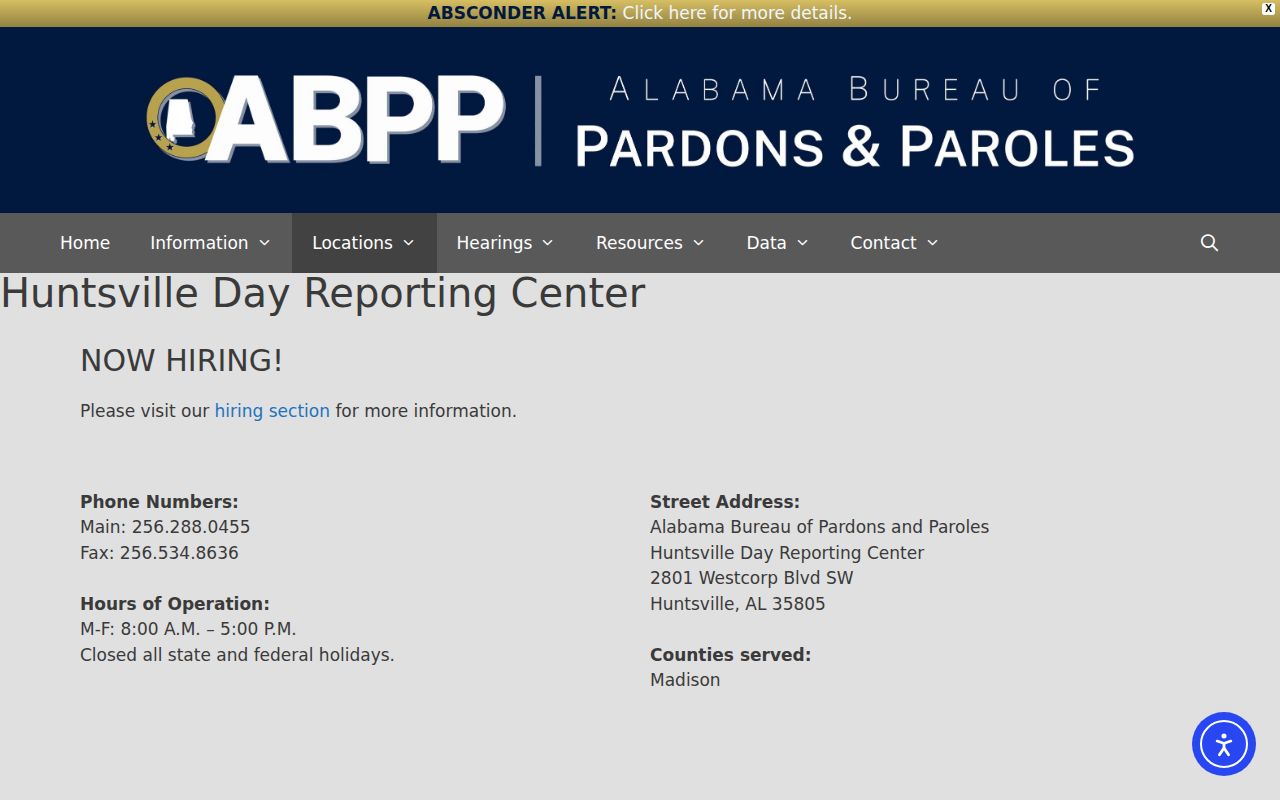
That local ABPP resource should be read together with the field-office page and the court record. It does not prove release by itself.
Madison County Parole Hearing Records
ABPP publishes several hearing-related resources that matter when a Madison County case has moved into the state-prison and parole system. The research identifies general hearing information, scheduled parole hearings, current-year parole results, previous-year parole results, and hearing minutes. The general hearing information source says parole and pardon hearings are held in open public meetings each week on Tuesday, Wednesday, and Thursday unless otherwise noted, at 301 South Ripley Street in Montgomery.
When reviewing those records, keep the custody words narrow. A scheduled hearing means a board review is on the calendar. A result means the board took action. A grant may still be followed by detainers, processing, rescission, added sentences, or a different custody status. Actual physical release is confirmed through ADOC, VINE, court records, or the receiving supervision record.
The ABPP scheduled parole hearings page is one of the official hearing sources captured for this build.
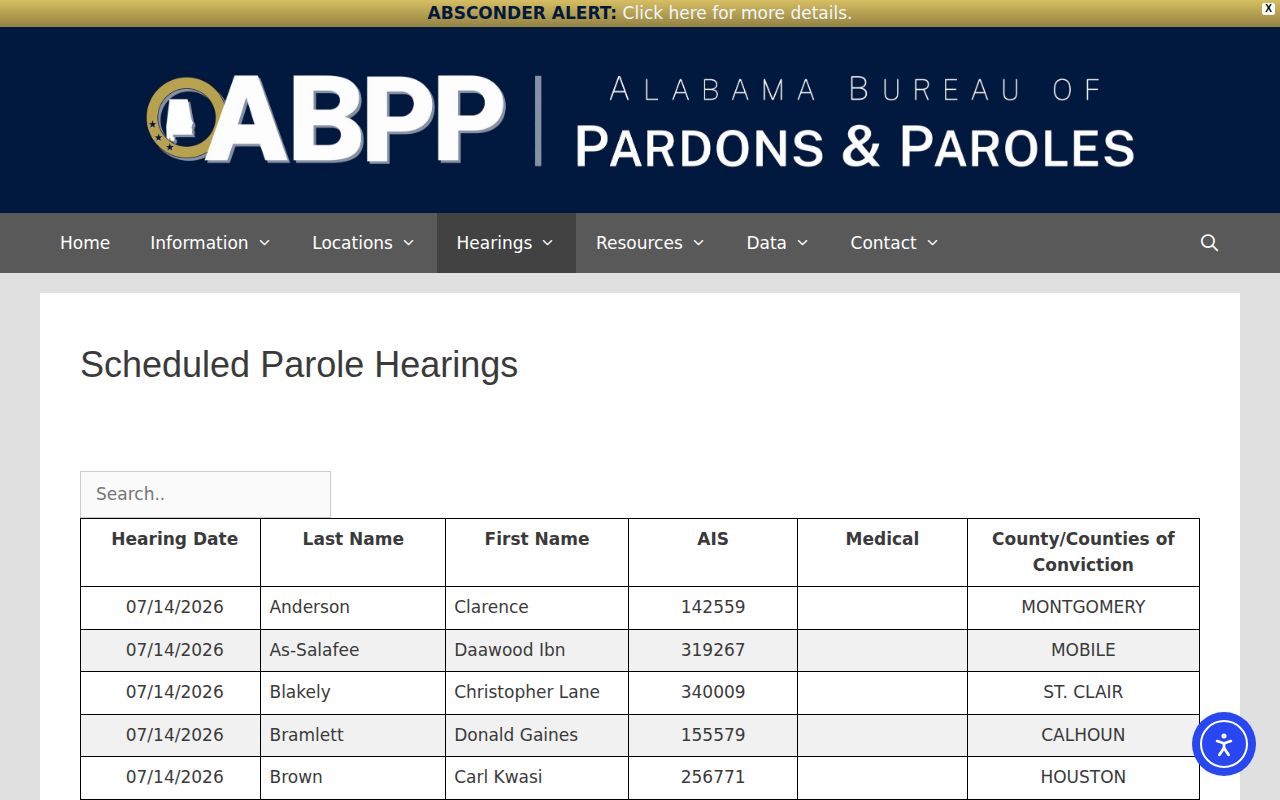
Use the person, case, and custody details from the official source that matches the event being checked.
Madison County Absconder Alerts
Conditions and violations should be discussed at a high level. A supervision condition is a rule set by the court, parole board, or supervision agency. A violation is an alleged failure to comply with those rules. If the violation is serious, it can lead to a warrant-like supervision issue, revocation, a return to custody, or a new court event. The public search path depends on which agency acted.
ABPP's absconder alerts are relevant for Madison County probation and parole checks, but they are not a normal released-inmate roster. Treat them as supervision-enforcement notices for people alleged to have absconded from parole or probation. Absence from an alert page does not prove that supervision is clear, ended, or never existed.
Important: A Madison County released roster entry confirms a jail-custody event, while an ABPP absconder alert concerns post-release supervision enforcement.
Madison County Release Logistics
The Madison County Sheriff's Office jail-information page adds practical details that often matter after a release. It says inmate personal effects are inventoried and stored, and property for housed inmates may be picked up at 815 Wheeler Ave by a person with valid photo identification. The same source says property is stored for 30 days and may be disposed of or donated after that period.
Released inmate funds have a separate local path. The research states that a released inmate can pick up remaining funds at the Pistol Permit Office, 603 Fiber Street, Huntsville, AL 35801, from 8:00 a.m. to 3:00 p.m., excluding holidays, with valid identification. These property and funds rules do not verify parole or probation status, but they help connect a confirmed jail release to the next local steps.
| Release-related item | Madison County source detail |
|---|---|
| Personal property | Inventoried and stored; pickup at the detention facility with valid photo identification. |
| Storage period | Property for housed inmates is stored for 30 days before disposal or donation may occur. |
| Remaining funds | Released inmate funds pickup is routed to the Pistol Permit Office on Fiber Street. |
Madison County Supervision Discharge
Supervision ends through a discharge, termination, completion, revocation, court order, or other agency action. The sheriff's current and released rosters do not serve as the full discharge record for parole or probation. For a state-prison case, ADOC and ABPP records are usually more useful. For a local probation sentence, the Madison County court record can show the order that created, modified, revoked, or ended supervision.
Alabama Code Section 15-22-28 governs parole consideration procedure, while Section 15-22-27.3 affects parole consideration for certain violent offenses. Good-time credit is separate under Alabama Code Section 14-9-41. Those sources explain why a parole date, supervision status, projected release, and final discharge may not match.
Note: If a formal supervision record is needed, use the agency public-records path instead of relying on a short web listing.